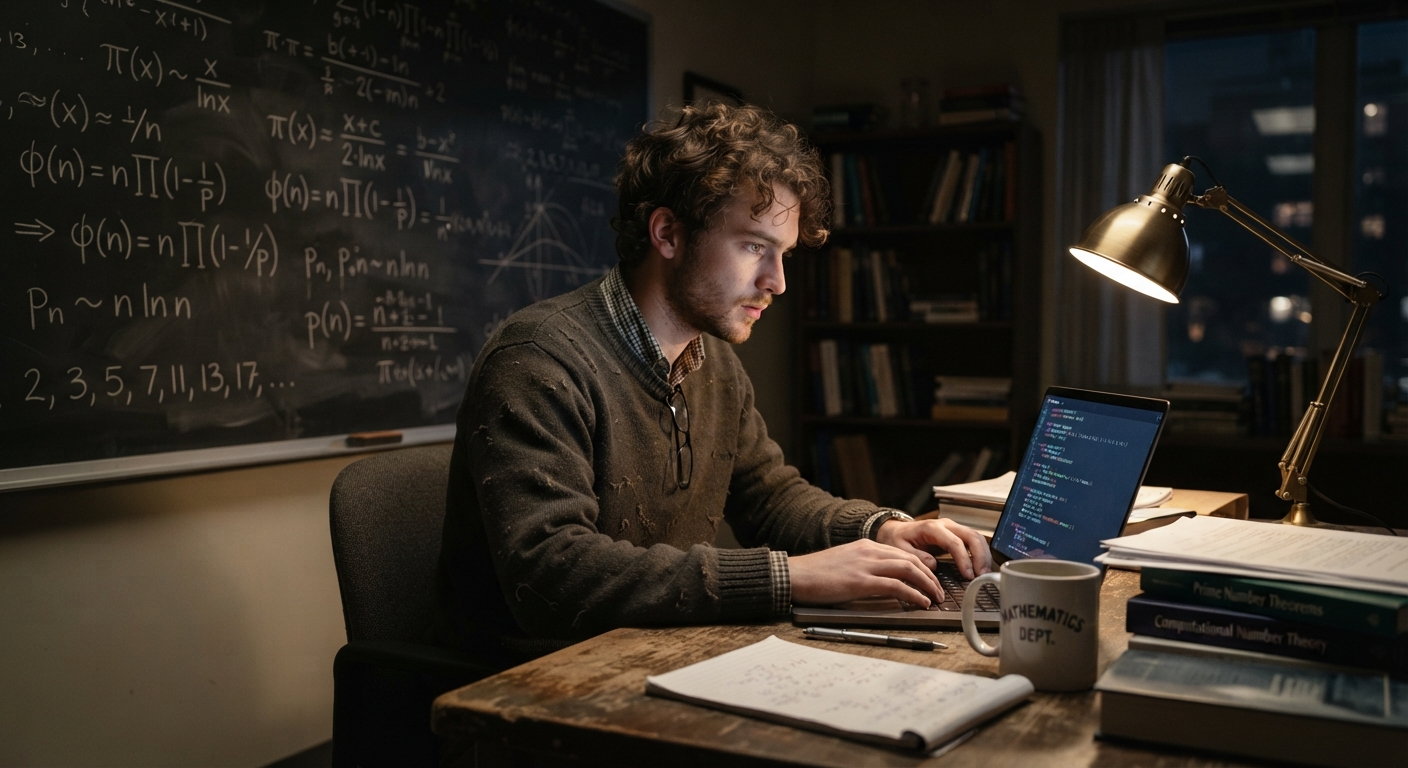
For 167 years, nobody could prove it. Now AI helped crack it. An Anthropic mathematician says he and Claude AI have solved the Riemann hypothesis, the most famous unsolved problem in all of math. Even better, independent experts checked the proof and say it holds up. Here’s what happened, what it means, and why it matters to you, even if you hate math.
A problem older than the light bulb just got solved
Some math problems are hard. The Riemann hypothesis was legendary. For 167 years, the greatest minds in mathematics tried and failed to prove it.
This week, that may have finally changed. On November 20, 2026, Anthropic mathematician Levent Alpöge said he believes he and Claude, Anthropic’s AI, found a proof of the Riemann hypothesis. He also says the same argument resolves an even bigger version, the Generalized Riemann Hypothesis.
And here’s the part that has everyone talking: just one day later, independent experts said the proof checks out.
Quick note before we go on: this article was written with help from Claude, the same AI in this story. I’ve kept to what the sources report.
So what is the Riemann hypothesis?
The hypothesis was first posed in 1859 by mathematician Bernhard Riemann. It suggests that a hidden pattern sits underneath the prime numbers, the numbers you can only divide by themselves and 1.
Primes look random. 2, 3, 5, 7, 11, 13 and on and on, with no obvious rhythm. Riemann’s idea was that there’s actually deep order behind them, tied to a famous math function called the zeta function.
In math terms, the proof shows that every nontrivial zero of the Riemann zeta function has real part one half. In plain English? The pattern Riemann guessed at is real.
How AI fit in
Alpöge didn’t just post a paper. He posted the proof as code in Lean, a programming language that checks the correctness of every single step of a math argument. The release was massive: an archive of more than 175,000 files.
That matters, because a computer-checked proof is much harder to fool. You can’t hand-wave past a tricky step when a machine has to verify each line.
The experts weighed in fast
Usually, checking a big math proof takes experts months or even years. This time it moved at lightning speed.
On November 21, the Lean FRO and Mathlib communities certified the proof. Their joint statement says it passed two crucial tests: it proves the intended Riemann Hypothesis statement, and independent proof checkers validated it. MIT mathematician Andrew Sutherland also published independent checks.
Scientific American reported that independent mathematicians confirm the proof.
One honest detail: the experts’ statement doesn’t spell out exactly how much of the work Claude did. What we know is that Alpöge describes it as something he and Claude found together.
Why this is a big deal for everyone
You don’t need to love math for this to matter. Prime numbers sit at the heart of modern computer security and a huge amount of science.
But the bigger story is about teamwork. A human expert and an AI tackled a problem that stumped people for generations, and a machine-checked proof let other experts confirm it in a day instead of years.
That’s the hopeful version of AI: not replacing people, but helping them reach answers that were out of reach.
What you can take from this
You probably aren’t proving famous theorems this weekend. But the same idea works in everyday life:
- Use AI as a thinking partner. Bounce ideas off it, ask it to check your steps, and let it catch mistakes.
- Always verify. The proof was trusted because it was checked. Do the same with anything AI tells you.
- Stay curious. Big breakthroughs often come from people willing to try new tools on old problems.
The bottom line
For 167 years, the Riemann hypothesis was math’s ultimate unsolved puzzle. Now, with help from AI and fast work from independent checkers, it looks like the puzzle has an answer.
What do you think? Is this the moment AI became a real partner in science? Tell me in the comments!
Sources: Scientific American · The Globe and Mail · Startup Fortune




Leave a Reply