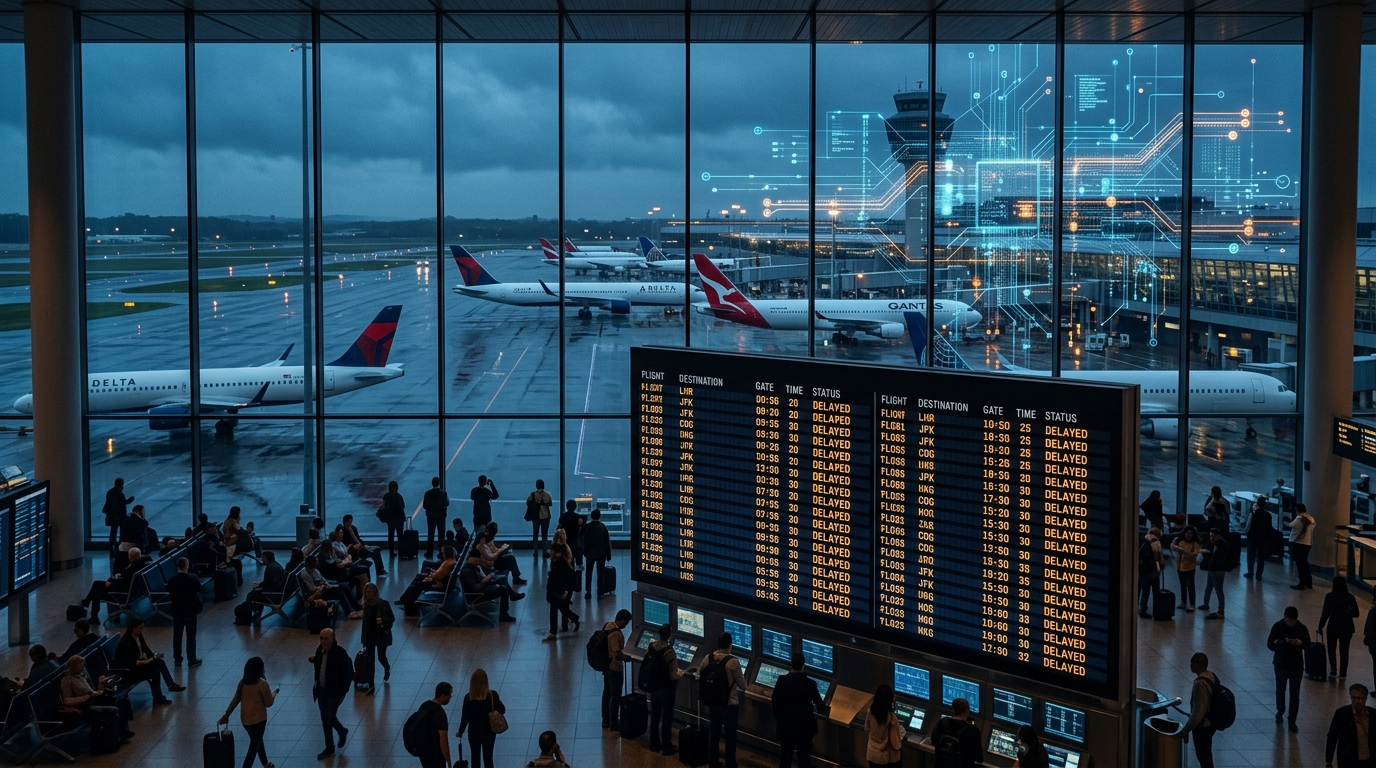
On Thursday, millions of people got kicked out of Outlook, Teams and Xbox. On Friday, every single flight in the United States was told to stay on the ground. Two huge tech failures, back to back, in less than 48 hours. And just two months earlier, the FAA had rolled out a brand new AI powered system to help manage America’s airspace.
So naturally, everyone started asking the same question: did AI just ground the entire country? Was Microsoft behind it? Was it a cyberattack?
The short answer is no, no and no. But the real story is still pretty unsettling, and it says a lot about how much of our daily life now depends on technology that most of us never think about until it breaks.
FAA Ground Stop: What Actually Happened
At 3:54 p.m. Eastern time on Friday, November 13, 2026, the Federal Aviation Administration grounded all flights in the United States “due to extraordinary circumstances and for reasons of safety.”
According to Northeastern Global News, the FAA said the ground stop followed “communication issues impacting multiple Air Route Traffic Control Centers.” Those are the big regional centers that guide planes once they’re high up in the sky between airports.
The stop lasted more than four hours. Transportation Secretary Sean Duffy announced Friday evening that it had been lifted, but warned that restarting operations would take time. CNBC reports that flight cancellations will stretch into the weekend, after thousands of flights were canceled or suspended and travelers were stranded in airports across the country.
Federal officials have since blamed aging FAA telecommunications equipment, and CNN reported that a network router problem, believed to have started at Chicago Midway, set it off. They’ve said there’s no sign the ground stop was connected to the Microsoft outage the day before, or to the FAA’s new AI traffic planning tool. And Homeland Security Secretary Markwayne Mullin said there’s no reason to believe it was a cyberattack.
Key Facts at a Glance
| Detail | Information |
|---|---|
| What happened | Nationwide ground stop for all US flights |
| When | Friday, November 13, 2026, at 3:54 p.m. Eastern time |
| Ordered by | Federal Aviation Administration (FAA) |
| Official cause | Telecommunications outage affecting multiple Air Route Traffic Control Centers |
| Blamed on | Aging FAA telecom equipment, with CNN reporting a network router problem believed to have started at Chicago Midway |
| Impact | Thousands of canceled flights and stranded travelers |
| Day before | A global Microsoft outage hit Outlook, Teams, Xbox Live and more |
| Connected to Microsoft? | No, according to officials and Microsoft |
| Connected to AI? | Officials say no link to the FAA’s new AI traffic planning tool |
| Cyberattack? | No indication, according to the Homeland Security Secretary |
| How rare is this? | Very. The last nationwide ground stop was in January 2023, and before that, after September 11, 2001 |
A Strange 48 Hours
To understand why so many people jumped to conclusions, you have to look at the timing.
On Thursday, November 12, Microsoft had a massive global outage. Millions of people lost access to Outlook email, Teams and other everyday office apps. Gamers got booted off Xbox Live. Businesses that run on Microsoft 365 basically ground to a halt for hours.
Then, barely a day later, every plane in America was ordered to stay put.
On top of that, some workers were also getting locked out of their workplace accounts thanks to separate problems with Workday, the HR software many big companies use. One local outlet summed it up perfectly as “a strange 48 hours.”
When that many big systems fail at once, it’s only human to wonder if they’re all connected. Honestly, I wondered too.
Was Microsoft to Blame? No
Microsoft was quick to shut that idea down. The company said there was no connection between its outage and the air traffic control problems.
Government officials agreed. “I don’t see any reason to connect those two at all,” Mullin told reporters on Friday afternoon, according to CNN. “Those are separate issues.”
So as weird as the timing was, these appear to be two completely different failures that just happened to land on back to back days.
Was AI to Blame? Here’s Why People Asked
This is where things get interesting for anyone who follows AI.
In September 2026, Transportation Secretary Sean Duffy unveiled a new FAA system called SMART, short for Strategic Management of Airspace, Routes and Trajectories. It’s designed to use AI to help plan air traffic. Duffy said it “centralizes 200 data streams” into one platform, and promised benefits like fewer delays and cancellations.
Not everyone was thrilled about it. The National Air Traffic Controllers Association, the union that represents air traffic controllers, said it wasn’t involved in the design, testing or rollout of the system. Some Democratic lawmakers also pushed back and sent the FAA questions about it.
So when the entire national airspace suddenly shut down just weeks after an AI system was plugged into it, plenty of people put two and two together.
But officials say that math doesn’t add up. They’ve ruled out a link between the ground stop and the new AI traffic planning tool, and pointed the finger at old telecom equipment instead.
How SMART Is Supposed to Work
Even though it wasn’t behind Friday’s chaos, SMART is worth understanding, because AI is clearly becoming part of how America’s skies are managed.
Here’s the basic idea. Air traffic planning depends on a huge amount of information: weather, flight schedules, airport capacity, runway conditions, plane positions and much more. Traditionally, that information is spread across lots of separate systems.
SMART pulls around 200 of those data streams into one platform. AI then helps planners spot problems earlier, like a storm that’s about to clog up a busy route, and suggests ways to reroute or space out flights before delays pile up.
| Part of the Job | How AI Is Meant to Help |
|---|---|
| Weather | Spot storms and predict which routes will get backed up |
| Scheduling | Balance how many flights head into busy airports at once |
| Routing | Suggest new paths when parts of the sky are congested |
| Delays | Catch problems early, before they snowball across the country |
| Big picture | Give planners one combined view instead of many separate screens |
It’s important to note what SMART is not. It’s a planning tool. Human air traffic controllers are still the ones talking to pilots and keeping planes safely apart.
The Real Problem: Old Equipment
Here’s the twist that should probably worry us more than any AI story.
The ground stop wasn’t caused by some futuristic robot gone wrong. It was caused by old communication gear. The FAA’s telecom systems are what connect air traffic controllers, radar and control centers across the country. When those links break, controllers can’t safely manage planes, so the only safe option is to stop flights from taking off.
This isn’t the first time aging FAA technology has caused a nationwide mess. The last full ground stop, in January 2023, happened when a pilot notification system stopped working. Before that, you have to go all the way back to September 11, 2001.
So while everyone is debating whether AI is ready to help run the skies, the more immediate issue might be that some of the basic plumbing underneath it is getting old.
What Travelers Went Through
For people stuck in airports, none of the technical details mattered much. They just wanted to get where they were going.
At New York’s JFK Airport, one traveler heading to Miami to catch a cruise told reporters there were at least 200 people in front of her in line, just for her Delta flight. Her husband started hunting for a hotel room nearby while they waited to hear when they could fly out.
Still, she said most people were calm and taking it in stride. That’s the thing about a nationwide ground stop. Everyone is in the same boat, or the same terminal, at least.
What This Means for AI and All of Us
There are a few big lessons here.
1. Not Every Tech Failure Is an AI Failure
AI is the hot topic right now, so it’s easy to blame it for everything. But Friday’s ground stop is a reminder to wait for the facts. Officials say this one came down to old equipment, not artificial intelligence.
2. Trust in AI Has to Be Earned
The fact that so many people immediately suspected the new AI system tells you something. When AI gets added to something as important as air traffic control, people want to know it was properly tested and that the experts who do the job every day were involved. The air traffic controllers’ union saying it was left out of the process didn’t help.
3. We Depend on Fewer, Bigger Systems Than Ever
One Microsoft outage can knock millions of people offline. One telecom failure can stop every plane in the country. As more of our world runs on a handful of big platforms, a single failure can ripple out further and faster than ever before.
What Happens Next
Expect a lot more questions in the coming weeks. Lawmakers are likely to push the FAA on how it plans to replace aging equipment, and the debate around SMART and AI in air traffic control isn’t going away.
Keep an eye on three things:
- The FAA’s full explanation of exactly what failed and why.
- Funding for new equipment, since this outage puts fresh pressure on upgrading the system.
- Oversight of SMART, including whether air traffic controllers get a bigger say in how AI is used.
The Bottom Line
No, AI didn’t ground every flight in America. And no, Microsoft didn’t either. According to federal officials, Friday’s nationwide ground stop came down to aging FAA telecom equipment.
But the fact that so many of us instantly suspected AI says a lot about where we are right now. AI is moving into the systems that keep our world running, from email to air traffic control, and people want proof that it’s safe. Meanwhile, the old technology underneath it all is showing its age.
The next time your flight gets delayed, it might not be the weather or the airline. It might just be decades old equipment that nobody has gotten around to replacing yet.






Leave a Reply