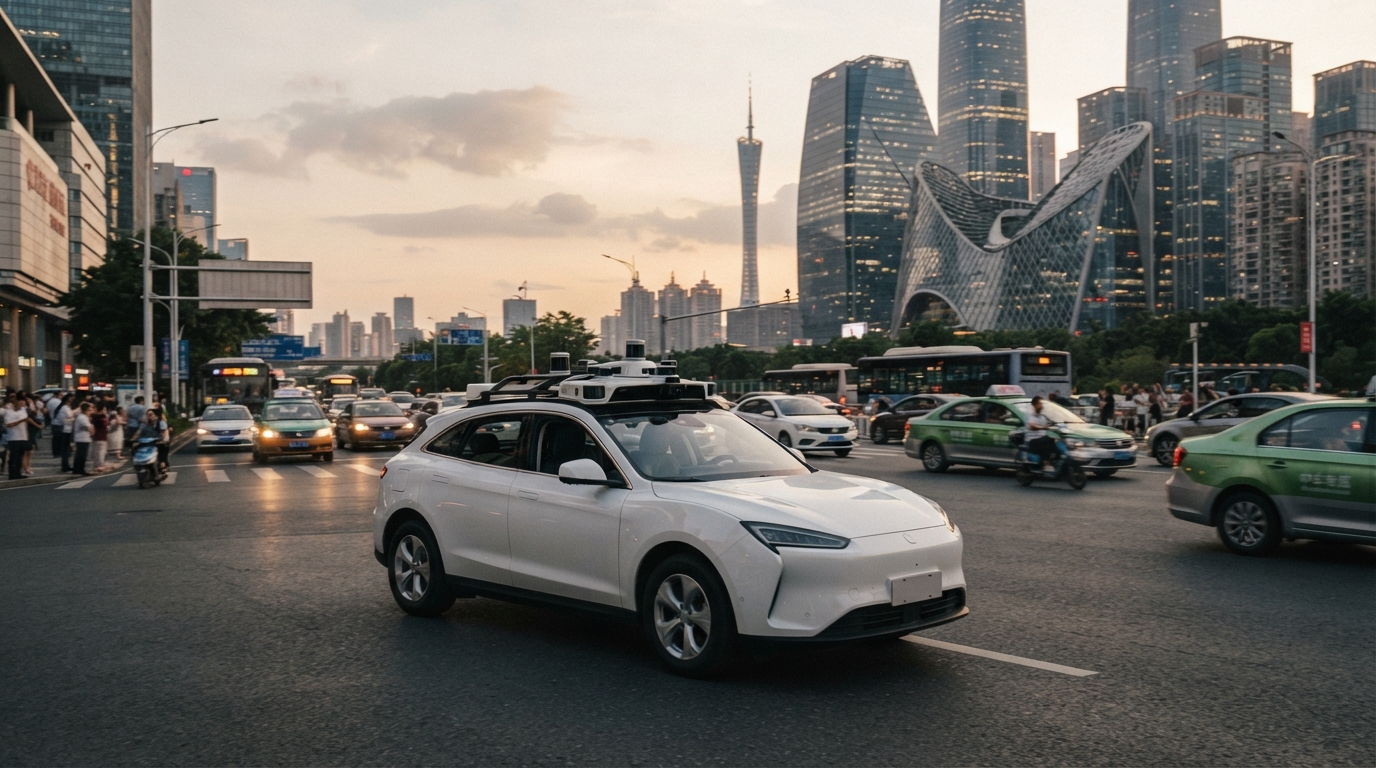
Imagine opening an app, ordering a ride, and watching a Toyota pull up with nobody in the driver’s seat. You climb in, the doors lock, and the car drives you across the city on its own. In Guangzhou, China, that’s now real life, any hour of the day or night.
Pony.ai and Toyota just launched fully driverless commercial rides with their new bZ4X Robotaxi. It’s one of the biggest steps yet toward a future where taking a taxi means no driver at all.
How the Toyota Robotaxi Works
A robotaxi is a taxi that drives itself. Instead of a human behind the wheel, AI handles the steering, braking, turns and traffic.
Here’s how a ride works in Guangzhou:
- Order a ride. Passengers open the PonyPilot app, or use Pony.ai’s mini programs inside popular apps like WeChat and Alipay.
- The car comes to you. A driverless Toyota bZ4X arrives at your pickup spot.
- Unlock with your phone. The car unlocks using Bluetooth, so there’s no key and no driver to greet you.
- Enjoy the ride. Inside, there’s a voice assistant, entertainment and climate controls you can set yourself.
- The AI drives. The car uses Level 4 self driving, meaning it handles the whole trip on its own within its service area.
Key Facts at a Glance
| Item | Details |
|---|---|
| Companies | Pony.ai and Toyota |
| Vehicle | Toyota bZ4X Robotaxi (Pony.ai’s seventh generation) |
| Where | Guangzhou, China |
| Announced | November 15, 2026 |
| Driver | None. Fully driverless |
| Hours | 24 hours a day |
| How to book | PonyPilot app, WeChat or Alipay |
| Self driving level | Level 4 |
| Goal | About 1,000 bZ4X robotaxis across major Chinese cities |
| Partnership since | 2019 |
What Makes This Launch a Big Deal
Robotaxis aren’t brand new. But this launch stands out for a few reasons.
First, it’s Toyota. When the world’s best known carmaker puts its name on a driverless taxi, it tells everyone this technology is moving from experiment to everyday life.
Second, this car was built for self driving from day one. According to Pony.ai’s official announcement, the bZ4X Robotaxi “was developed from the ground up for Level 4 autonomous driving.” That includes backup systems designed to keep the car operating safely if one part fails.
Third, it’s built for mass production. The first one rolled off the production line in February 2026. Now, as The AI Insider reports, the companies are working toward deploying about 1,000 of them across major cities in China.
A Partnership Years in the Making
Pony.ai and Toyota didn’t team up overnight. They’ve worked together on several generations of robotaxis since 2019, bringing services to Beijing, Shanghai, Guangzhou and Shenzhen.
In 2023, Pony.ai, Toyota Motor China and GAC Toyota agreed to form a joint venture with an investment of more than 1 billion yuan to speed up production and get more robotaxis on the road.
The partnership goes beyond building cars. Toyota is also helping with the less glamorous work that keeps a fleet running, like maintenance, charging and routine servicing.
“Bringing the bZ4X Robotaxi into commercial service demonstrates what can be achieved by combining Pony.ai’s proven Level 4 autonomous driving technology with Toyota’s world class vehicle engineering and manufacturing expertise,” said Dr. Luyi Mo, vice president of Pony.ai.
What Riding One Feels Like
Pony.ai says the new model is more comfortable than earlier versions. Improvements to the self driving system give the car smoother acceleration, braking and cornering, so the ride should feel less robotic.
Why This Matters for You
You might be thinking, “That’s in China. Why should I care?” Here’s why.
- It’s coming everywhere. Driverless taxis are already running in some U.S. cities, and companies around the world are racing to expand. What works in Guangzhou today could show up in your city sooner than you think.
- Cheaper rides could follow. Without a driver to pay, robotaxi rides could eventually cost less than a regular taxi or rideshare.
- Safer roads are the goal. Supporters say AI drivers don’t get tired, distracted or angry. Still, the technology has to prove it can handle every surprise the real world throws at it.
- Jobs will change. If robotaxis spread, millions of people who drive for a living could feel the impact.
What Happens Next
- More cities. Pony.ai and Toyota are already testing the bZ4X Robotaxi in other major Chinese cities.
- A bigger fleet. As production ramps up, more of these cars will join the fleet.
- More competition. Other companies are racing to build their own driverless fleets, which could push the whole industry forward faster.
Why the Toyota Robotaxi Has Me Excited
I’ll admit, the idea of getting into a car with no driver still feels a little strange to me. But I think that’s how every big change feels at first. People were nervous about elevators without operators too, and now nobody thinks twice.
What excites me most is seeing a name like Toyota behind it. Toyota is known for building cars that last, so if it’s betting on driverless taxis, I believe this future is closer than most people realize.
Would you ride in a car with nobody behind the wheel? Or would you rather keep a human driver for now? Let me know in the comments.





Leave a Reply