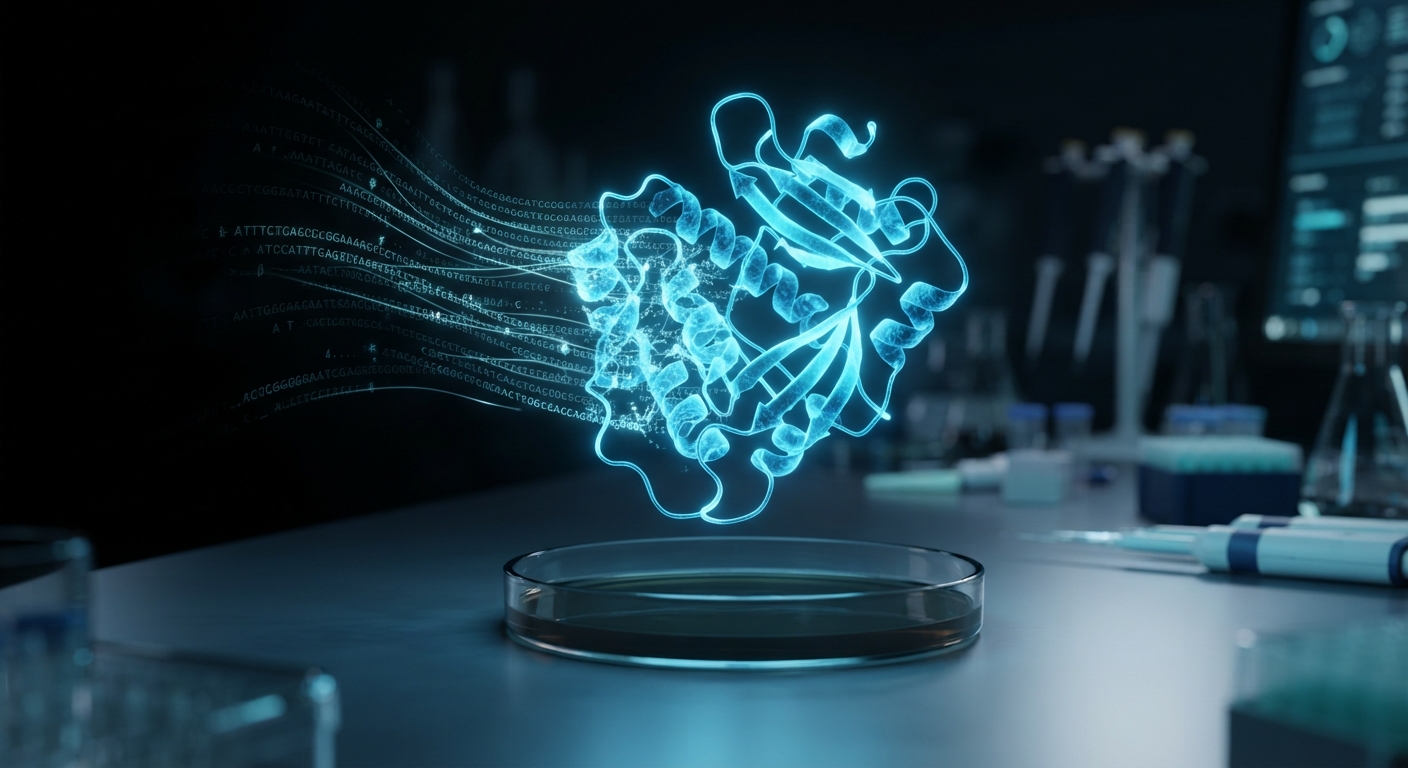
Thirty five tiny proteins, sitting in a lab dish, stuck to exactly what they were supposed to stick to. Nobody with a biology degree designed them. A chatbot did.
That is the short version of what OpenAI published on November 24, 2026, and computational biologists have been arguing about it ever since. Its GPT-6 models designed brand new proteins from scratch using nothing but reasoning and ordinary coding tools. No specialized biology software did the creative work. Then a lab actually built them and tested them.
That last part is what separates this from the usual AI announcement. Designing a protein on a computer is one thing. Having it work in a tube is another entirely, and plenty of beautiful computational designs fall apart the moment they meet real chemistry.
OpenAI is not alone here either. Back in October, a research firm reported that two labs had confirmed 17 binders designed by Anthropic’s Claude against scorpion toxins. Two of the biggest AI labs are now putting general purpose models into wet lab biology, and Nature reported on November 24 that the GPT-6 release intensified an already frenzied debate among computational biologists over how well these models really handle protein science.
What GPT-6 Actually Did
OpenAI released a preprint called GPT-6 as a Universal Foundation Model for Protein Biology: Beyond Specialized Models. The core claim is that the GPT-6 family can design new protein structures and sequences without relying on specialized biology models, using only reasoning and general purpose coding tools.
Here is why that is a big deal. Until now, protein design meant running a chain of specialist AI tools. RFdiffusion builds the shape. ProteinMPNN fills in the amino acid sequence. ESMFold checks whether the sequence would actually fold that way. Each tool takes its own kind of input, each has its own quirks, and coordinating them takes real expertise. You cannot just hand one a new requirement it was not built for without changing the software or retraining it.
GPT-6.2 did the structural design work the way it would tackle a math problem. It looked at the target protein’s surface, reasoned about how two proteins might fit together, then wrote and ran its own code to explore shapes and amino acid choices. OpenAI’s own example walks through the model designing a binder for IL-7Rα: it examines the target surface, arranges five coiled sections into a protein shape, and checks how the two would fit.
And because it is a general model, you steer it with plain English. Tell it where the protein should attach. Tell it you want three coils and two strands. It follows.
Key Facts at a Glance
| Item | Detail |
|---|---|
| Announced | November 24, 2026 |
| Who | OpenAI, with lab partner Onava |
| Models tested | GPT-5.6, GPT-6, GPT-6.2, plus an unreleased internal research model (called “the internal model” below) |
| Headline lab result | 35 of 322 designed minibinders (10.9%) bound their target |
| Targets hit | PD-L1 (5 hits), IL-7Rα (3), TrkA (1), VEGF-A (8), IL-17A (18) |
| Sequence redesign | 85% binding on MDM2, 62% on VEGF-A, 14% on PD-1 |
| Antibody loop redesign | 128 of 182 designs (70%) still bound IL-4Rα |
| Small molecule docking | 93% accurate for GPT-6.2 vs 50% for the specialist tool DiffDock-L |
| Biggest weakness | Predicting a full protein structure from sequence: 0.38 TM-score vs 0.93 for ESMFold2 |
The Seven Functions, and Who Can Actually Use Them
This is the part worth reading slowly. OpenAI tested GPT-6 on fourteen separate protein tasks, and the model is much stronger at some than others. Here is each capability, how it works, and the kind of job it fits.
1. Minibinder design: building a small protein to grab a target
You give the model a 3D structure of a target protein and mark the exact spot where you want something to attach. The model writes code to generate small protein shapes that fit that spot. OpenAI gave GPT-6.2 five target structures and marked the attachment sites, and it produced designs without touching a specialized protein model.
In computational quality scores, GPT-6.2 came in slightly below RFdiffusion, the current standard. OpenAI’s unreleased internal model scored higher than RFdiffusion.
Who this is for: drug discovery teams at biotech firms, immuno-oncology researchers, academic structural biology labs. If your job involves finding a molecule that blocks a specific protein interaction, this is your function.
2. Sequence design: deciding which amino acids go where
A shape is useless without a sequence that folds into it. OpenAI gave GPT-6.2 3D models of existing minibinders, hid the original sequences, and asked it to write new ones.
The results were strong. In initial lab screens, binding showed up in 75 of 88 designs for MDM2 (85%), 26 of 42 for VEGF-A (62%), and 8 of 59 for PD-1 (14%). The sequences it wrote were not copies: the median difference from the original was 50% for VEGF-A and 43% for MDM2.
The memorization test matters here. OpenAI also gave it three unpublished minibinder shapes, and 14 of 107 proteins made from its new sequences (13.1%) bound. For one PD-L1 shape it produced two sequences that each differed from the original at 52 and 58 of 90 positions, and differed from each other at 44 positions. Both bound. That is hard to explain as recall.
Who this is for: protein engineers, enzyme developers, biologics manufacturing teams who need a variant that behaves the same but expresses or purifies better.
3. Antibody affinity maturation: tuning the grip
Antibodies grab their target with three loops. Researchers redesign those loops to make the grip tighter or more selective, a process called affinity maturation. OpenAI handed the model six small antibodies (VHHs) against IL-4Rα with the loops removed and asked for new loop sequences. Of 182 designs tested, 128 (70%) showed binding.
They then pushed harder, taking five real therapeutic antibodies and asking the model to change roughly half the amino acids in each of three loops while leaving everything else alone. Of 272 fragments tested, 179 (66%) still bound PD-1 or PD-L1.
Who this is for: antibody engineering groups, therapeutic antibody developers, diagnostics companies tuning reagent specificity. This is arguably the most immediately usable result in the whole paper.
4. Motif scaffolding: building a protein around a fixed core
Enzymes work because a few specific amino acids sit in a precise arrangement at the reaction site. Those amino acids can be far apart along the chain. The design challenge is building the rest of the protein so that when it folds, it brings them together and holds them there.
OpenAI ran 30 challenges from MotifBench. In preliminary analysis, 43.7% of designs from the latest internal model passed both checks, against 27.8% for RFdiffusion. That is a clear win over the specialist.
Who this is for: industrial enzyme design, green chemistry, carbon capture research, food science, detergent and biofuel companies. Anyone whose product is a catalyst rather than a drug.
5. Small molecule docking: predicting where a drug binds
Most medicines, aspirin included, are small molecules rather than proteins. Docking means predicting where a compound lands on a protein and which way it faces, which tells chemists how to modify a candidate so it binds harder.
On the PoseBusters dataset, with no hint about where the molecule bound, GPT-6.2 matched the observed position and orientation in 93% of scored predictions. The internal model hit 96%. The specialized docking tool DiffDock-L managed 50%.
Then comes the part that shows what a general model buys you. On the Scarpino dataset, researchers told the model in the prompt which two atoms formed the bond, and asked it to work out the rest. GPT-6.2 hit 92%, the internal model 97%, DiffDock 60%. You cannot type that kind of hint into a specialized tool. You just can with a GPT model.
Who this is for: medicinal chemists, small molecule pharma, computational chemistry teams, contract research organizations. Of everything here, this is the function closest to being useful today.
6. Mutation effect ranking: deciding what to make first
You can design a thousand variants on a computer and afford to build twenty. Ranking them is the whole game. OpenAI gave the models a starting sequence plus 50 modified versions, told them what property had been measured, withheld the answers, and asked for a ranking, with no coding tools, reasoning only.
Across 265 sets from a protein stability study, rank correlation climbed with each generation: 0.41 for GPT-5.6, 0.52 for GPT-6, 0.57 for GPT-6.2, 0.66 for the internal model. Across all four datasets, GPT-6.2 and the internal model ranked more accurately on average than ESM2-650M, a specialized protein model.
Who this is for: anyone planning wet lab work. Lab managers, principal investigators, process development scientists. This is triage, and triage is where research budgets quietly disappear.
7. Plain language structure control
In computational tests, the models consistently designed minibinders that contacted the required spots on the target. Researchers could specify the structural class, all helices, all strands, or a mix, and control the number of coils and strands with near perfect fidelity. They could go finer still, specifying which target amino acids should be buried on binding, or that the two proteins should interact through a particular kind of contact.
OpenAI’s framing is that researchers will one day guide protein design the way they guide image generation today, by describing what they want.
Who this is for: this is the one that opens the door to people who are not computational specialists. Bench scientists, PhD students, lab techs. If the interface is English, the expertise barrier drops hard.
Where It Falls Short
OpenAI is unusually blunt about the gaps, which is worth crediting.
First, this was not a solo performance. The design campaign leaned on specialized models to filter candidates, Boltz-2, OpenDDE and ESMFold2, and SolubleMPNN supplied the amino acid sequences in the first lab experiment. OpenAI says plainly that the results do not yet establish that its models can generate new minibinders end to end without help.
Second, full structure prediction remains a real weakness. Given only a sequence and asked to predict the fold, average TM-score went from 0.16 for GPT-5.6 to 0.26 for GPT-6.2 to 0.38 for the internal model. ESMFold2 averaged 0.93. That is not a narrowing gap, that is a different league. OpenAI calls this the jagged capability frontier, and it is a fair description: the same model that beats a specialist at docking gets beaten badly at folding.
Third, some benchmark numbers need a careful reading. Where models were asked to infer sequences from structures, unusually high accuracy may partly reflect memorization or artifacts in how those structures were generated.
Fourth, and most important for anyone thinking about medicine, binding is one step. A protein that sticks to its target still has to prove specificity, stability, biological activity, manufacturability, safety and efficacy. Most candidates die at one of those gates, and nothing here changes that.
What OpenAI says comes next
Three stated goals: find binders for harder targets, design for what happens after binding rather than binding alone, and extend the work beyond minibinders to multi-target molecules, RNA, and small molecules including PROTACs, which direct a cell to destroy a specific protein.
What This Means for Your Job
Strip away the benchmark numbers and here is the practical read, depending on where you sit.
If you run a wet lab, the change is fewer design and test cycles, and less dependence on the one person who knows how to drive the specialist tool chain. You describe what you want in English and iterate. OpenAI’s stated goal is exactly that: shorten each round and cut the total number of cycles needed to find something that works.
If you are in drug discovery, the docking and mutation ranking results are the ones to act on now. They are not glamorous, but they decide which twenty of your five hundred candidates get made, and that decision is where most research money gets spent well or badly.
If you work in antibody engineering, the 70% and 66% loop redesign numbers are the strongest signal in the paper. That is close to usable.
If you build protein design software, your tools still win on the hardest task, full structure prediction, by a wide margin. But a generalist just matched or beat you at backbone generation and sequence redesign, which were two of your core jobs. Worth watching closely.
If you are a bench scientist with no computational background, this is the first version of this technology where the interface might be a conversation rather than a command line.
And if you are outside biology entirely, the pattern here is the thing to notice. A general purpose model, with no biology specific training, matched purpose built scientific software on several real tasks by reasoning and writing code. That same pattern will show up in other fields.
GPT-6 Protein Design and Biosecurity: The Part Nobody Should Skip
OpenAI raises biosecurity directly, and it deserves more than a footnote. The same capability that designs a protein to block a cancer signal could design something harmful. OpenAI points to its Preparedness Framework as the mechanism for assessing those risks and testing safeguards.
It is worth being clear eyed about the trade. Lowering the expertise barrier is the entire selling point of this work. That barrier was also, quietly, a safety feature. A tool that lets a PhD student design a binder without specialist training is the same tool in anyone else’s hands.
This is still a preprint, not a product. But the direction is set, and OpenAI’s long term goal is stated plainly: scientists describing the molecule they want in plain language, and getting candidates to test. The question of who gets to type into that box will matter as much as how well it works.
For now, treat this as what it is. Early, real, partly dependent on older tools, and genuinely surprising in a few specific places. In a field where most announcements never touch a lab bench, 35 proteins that actually bound is not nothing.



Leave a Reply